

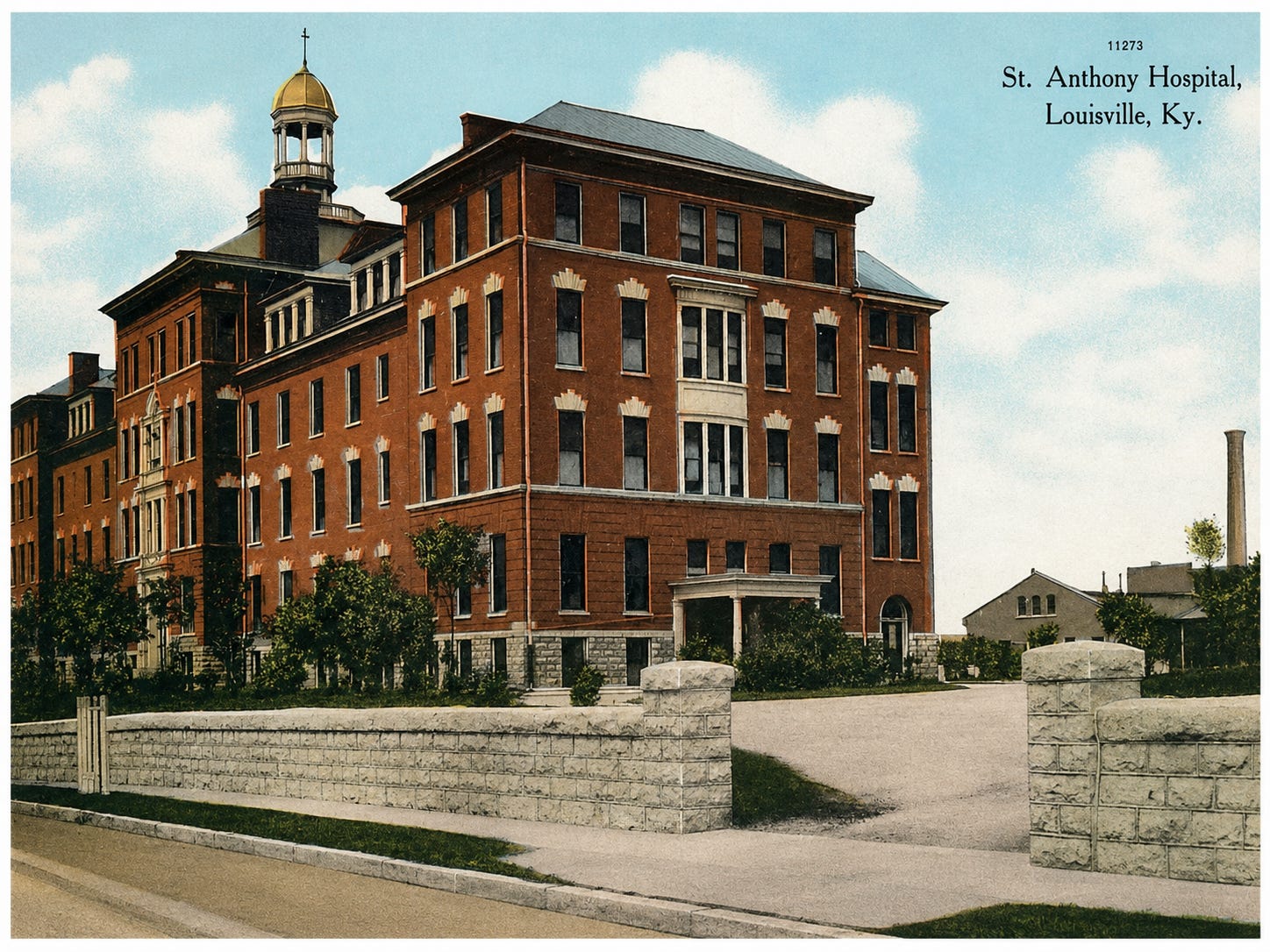
There are two places in Louisville that mark the boundaries of my life.
The first is St. Anthony’s Hospital in the Highlands, where I was born in 1976, a son of the Bicentennial. The second is Section A of Cave Hill Cemetery, where I will someday be buried among my family. Only a few city blocks separate them.
On a map, the distance between the beginning and the end of my story is surprisingly small.
I have spent much time looking at maps. They show where people settled, where roads once ran, where streams disappeared beneath neighborhoods, and where families crossed rivers in search of land, work, or religious freedom. A map can help explain why people met, why they married, why they attended a certain church, and why they were buried in a particular cemetery.
But a map can also reduce a life to something almost unnervingly simple.
A point where the story began. A point where it will end. A line between them.
Everything else must somehow fit inside.
I think about this when I remember Gustav Spangenberg’s The Train of Death at the Alte Nationalgalerie in Berlin1. Death moves through the painting not as an accident or interruption, but as a procession. People from every station of life are drawn into it. Rank offers no escape. Wealth provides no private exit. Youth receives no permanent exemption.
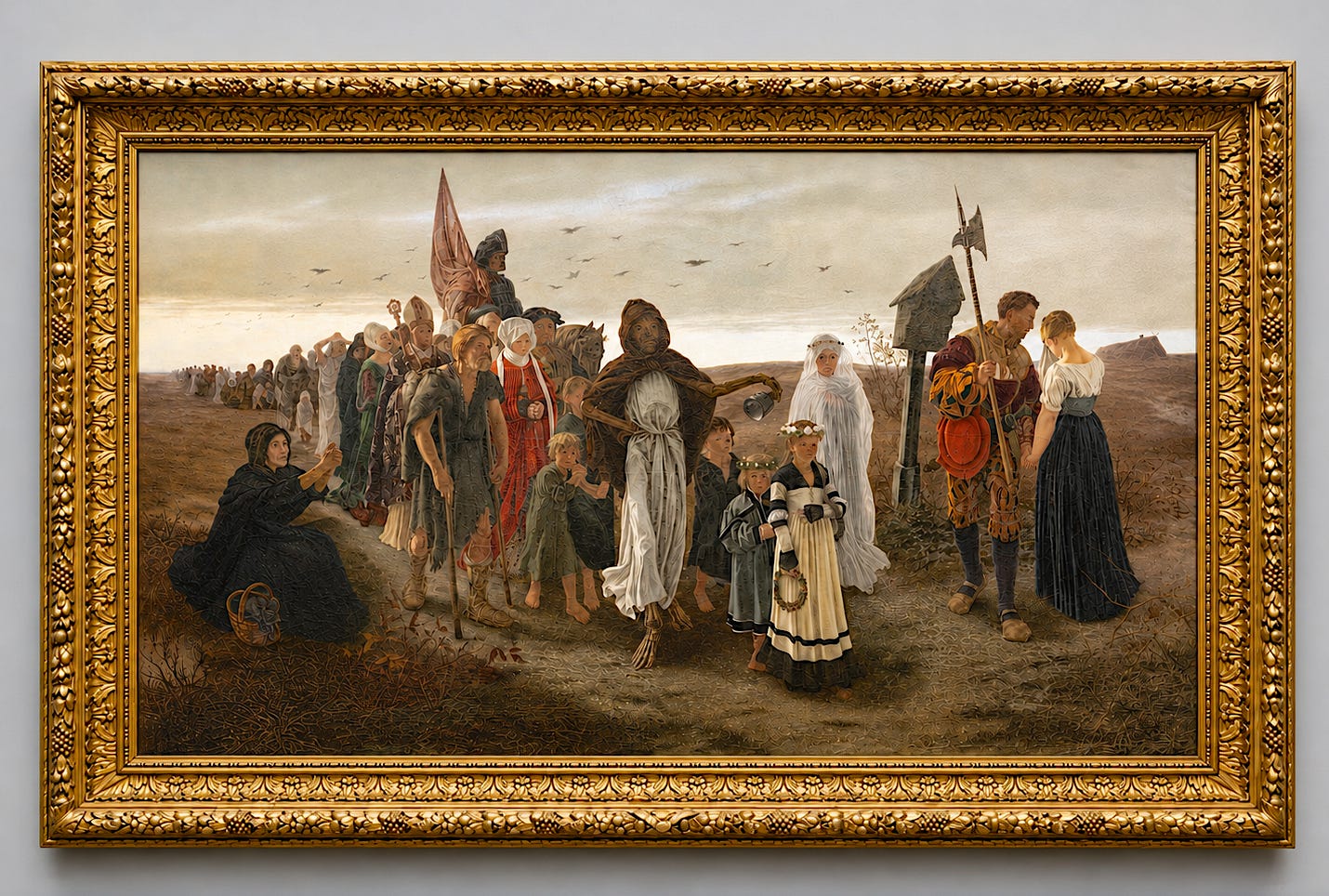
The painting is unsettling, but I do not find it cruel. It simply asks us to look at something we spend much of our lives trying not to see.
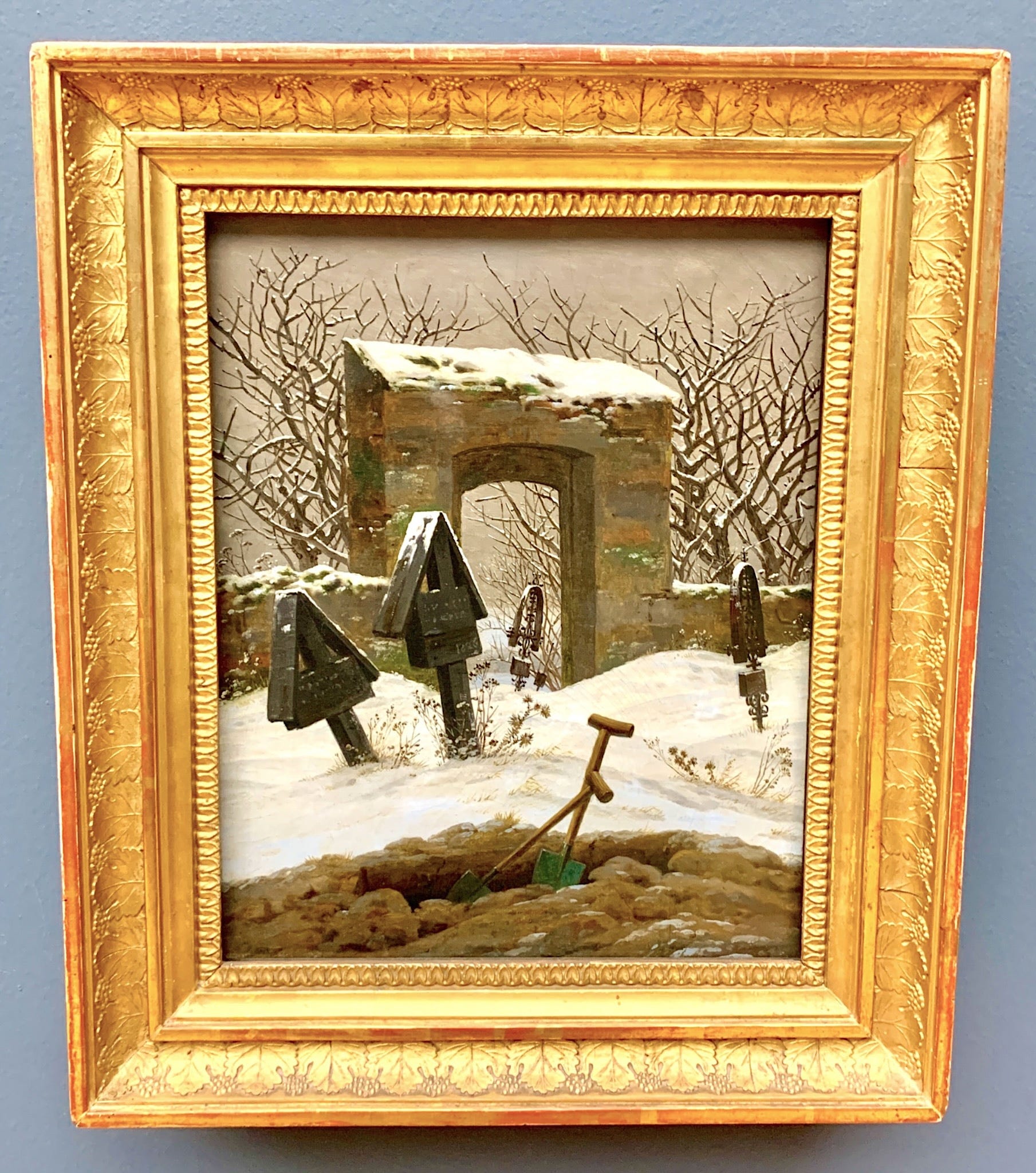
I feel something similar in the paintings of Caspar David Friedrich. A solitary figure looks across a landscape swallowed by fog. Moonlight settles over water. Bare trees rise against a winter sky. Human beings appear small in his work, but never meaningless. They stand for a moment inside a world that existed before them and will continue long after they are gone.
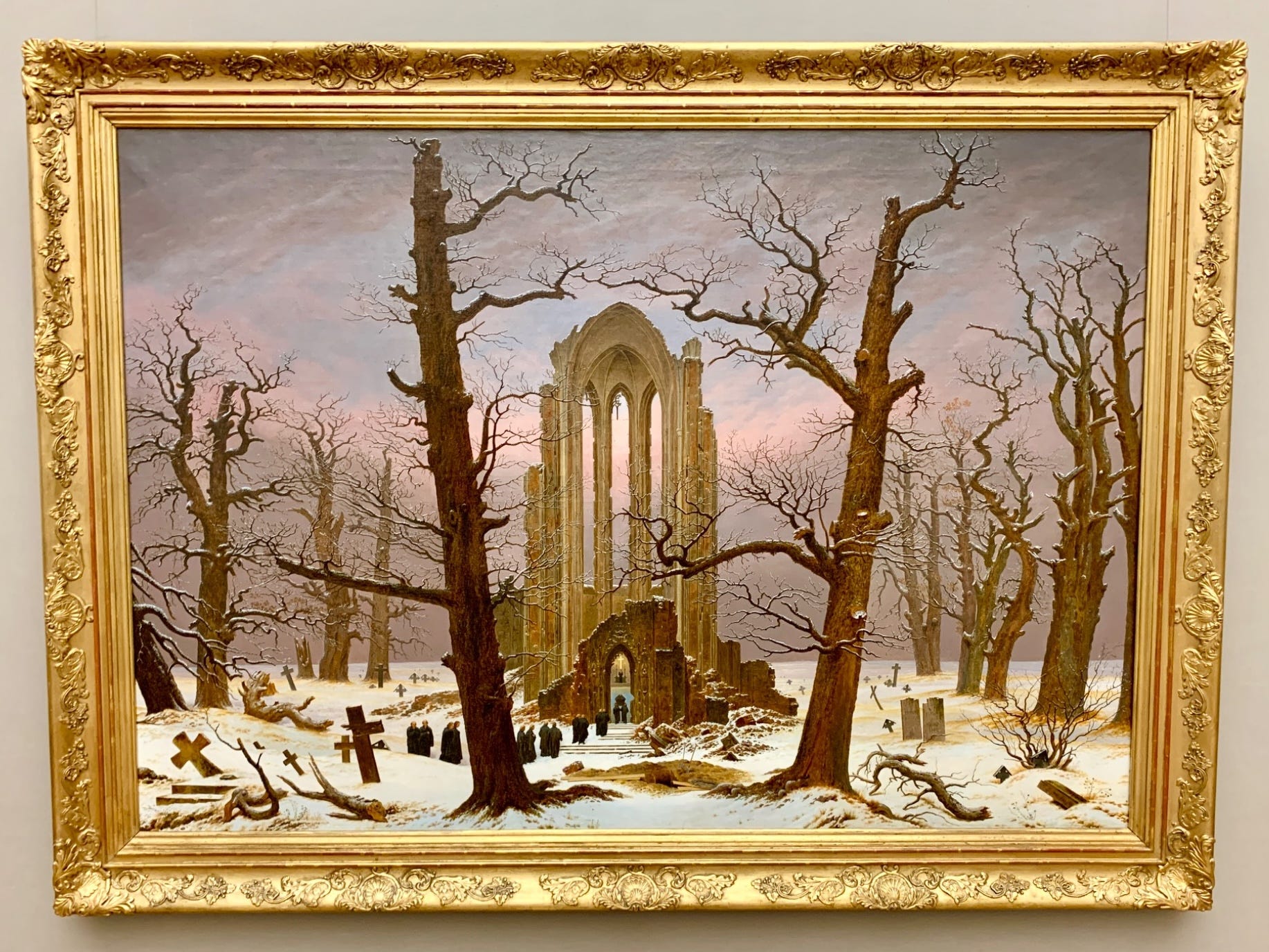
In The Abbey in the Oakwood2, a small funeral procession moves through a winter landscape toward the ruins of a Gothic church. The building has outlived the people who once worshiped there, yet it too is surrendering to time. Still, the journey does not feel meaningless. The figures move together beneath the bare oaks, carrying one of their own toward a final resting place. There is grief in the scene, certainly, but also order, companionship, and acceptance. No one travels the last distance entirely alone.
There is another connection I did not notice at first. Friedrich spent most of his adult life in Dresden beside the Elbe, while Spangenberg was born downstream in Hamburg, where the same river meets the wider world. Later, in Berlin, Spangenberg lived and worked near the Spree. Their lives3, like so many of the lives I have spent years tracing, unfolded beside moving water.
Perhaps that is one reason their work feels familiar to me. My own story has always had a river running through it. The Ohio carried my ancestors toward Kentucky, shaped the place where Louisville began, swallowed Corn Island itself, and still moves past the city as it has through every generation of my family. Rivers are good reminders that nothing stays exactly where we leave it. Shorelines change. Islands disappear. People come and go. Yet the river continues, carrying traces of the places and lives that have touched it.
Maybe that is what Friedrich understood so well: the landscape is never merely a backdrop to a human life. It is larger than us, older than us, and indifferent to our desire to remain.
Friedrich’s figures rarely seem interested in conquering the landscape. They simply face it. They stand before mountains, forests, seas, and enormous skies with what feels to me like an understanding: the world was here before them, and it will remain after they are gone.
I recognize something in that.
My own time here is finite. I do not know how much of it I have, and I am in no hurry to find out. There is still work I want to do, stories I want to tell, places I want to see, and people I want to help. There are seasons I still want to witness.
But knowing that my time is limited makes the work feel more urgent, not less. Records are still sleeping in courthouses and church basements. Cemeteries are waiting to be documented. Family stories are hanging by a thread, known only to one aging person who may never have been asked the right question.
Acceptance is not the same as eagerness. Nor is it despair or indifference to living. Perhaps it is simply the decision to stop treating death as though it were an administrative error that can be corrected if we refuse to open the letter.
Genealogy makes that kind of denial difficult.
For years, I have worked among the dead. I have searched for them in census schedules, deeds, tax lists, church registers, newspapers, libraries, family Bibles, and weathered stones. I have walked through cemeteries where the names remain sharp and legible and through others where time has nearly finished its work. I have stood over graves marked only by sunken ground and wondered who was placed there, who mourned them, and how a person could live an entire life only to disappear from the record.
Cemeteries have never seemed lifeless to me. They are among the most human places we have.
Every stone represents a gathering that once occurred. Someone stood beside an open grave. Someone heard the earth strike the lid of a coffin. Someone returned to a house where a chair was suddenly empty. Someone knew the private meaning of a name that now appears to us as little more than an inscription.
This is why I have called cemeteries fragile archives. They hold information, but they also preserve evidence of attachment. A grave marker says that someone was here and that someone else believed the fact deserved to be recorded.
Someday, my name will be added to the family monument at Cave Hill, not standing alone, but among my own.
There is comfort in knowing where it will stand. Section A of Cave Hill is not an abstraction to me. It is part of the geography of my family. Across the cemetery, I can trace at least seven generations through various paternal and maternal lines. My burial there will place me among the people I have loved in this life and among generations who came before me, some remembered through family stories and others recovered through records, photographs, and the traces they left behind.
And Cave Hill is only part of that geography. Not far away, in St. Michael, St. Louis, Calvary, and Eastern Cemeteries, lie hundreds of my ancestors and cousins. Taken together, those five cemeteries hold more than 300,000 souls4, far more than live above ground in the same part of Louisville today. I sometimes think of the Highlands that way: not simply as a neighborhood of houses, streets, churches, and shops, but as a place where the dead vastly outnumber the living. Beneath the familiar landscape is another city altogether, one made up of generations who lived here before us and, in ways both obvious and hidden, helped make the place what it is.
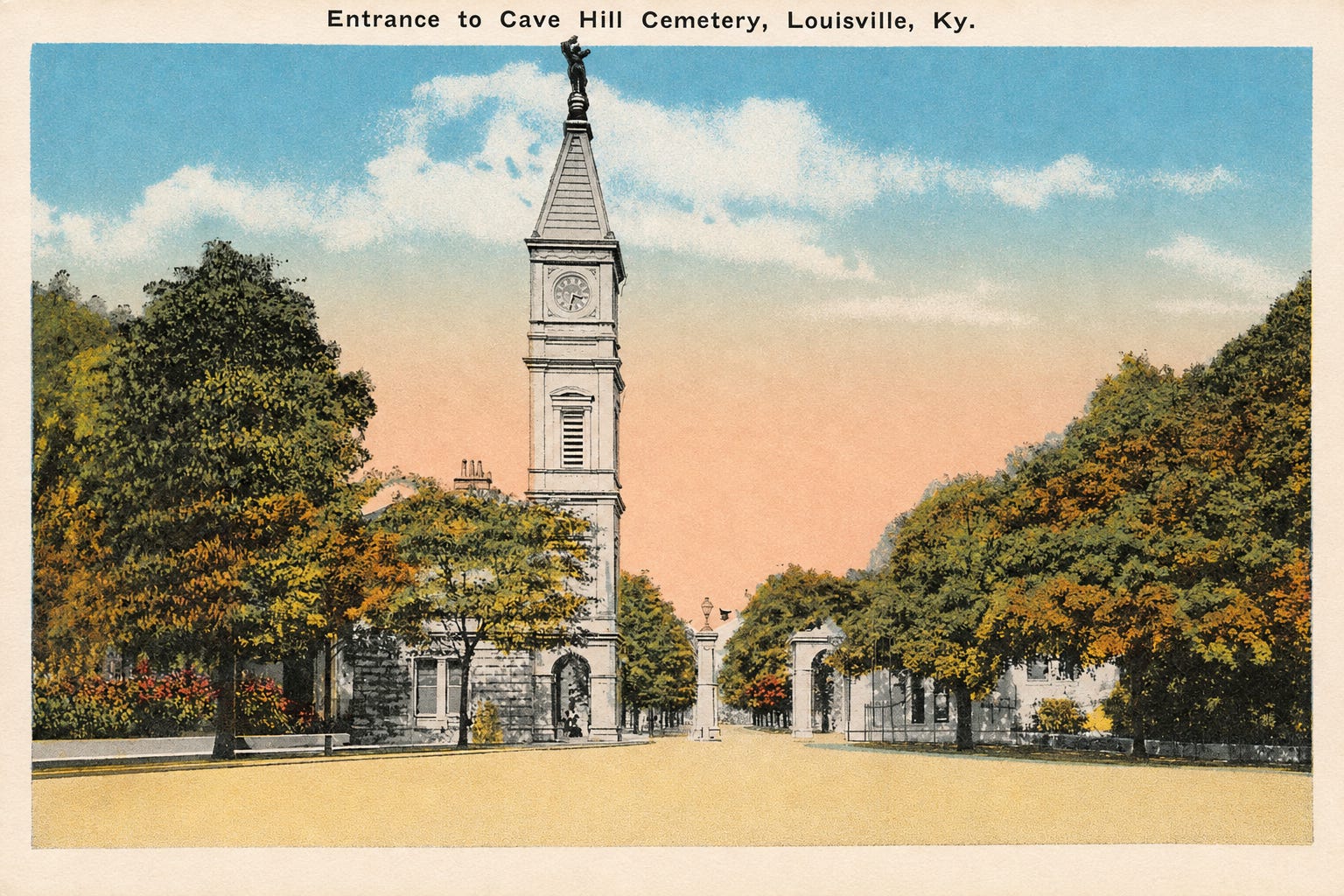
I have spent much of my life searching backward for them. One day, I will be there too.
That thought does not frighten me as much as one might expect. Perhaps family history has made death feel less like exile. The dead are not entirely gone when their names remain in our houses, when their faces look out from photographs, when their choices continue to shape where we live and what we believe.
I know too much about the persistence of the past to believe that a life ends cleanly.
My father survives in the stories we repeat, in the sound of a banjo, in the cling of horseshoes being pitched, in habits passed through his brothers and sisters and dozens of their descendants. My grandmother survives in her paintings and in the way her family still looks at a Kentucky landscape. Ancestors I never met remain present in the roads they traveled, the churches they helped build, the land they cleared, and the names they carried forward.
Even Corn Island, long since taken by the Ohio River, remains part of my story.
My ancestors Andrew and Sally Kimbley came there in 1778 with George Rogers Clark’s expedition, as did another of my direct ancestors, Jacob Van Meter, who had helped recruit some of the roughly 175 men who made the journey by flatboat from the Redstone Settlement in Pennsylvania.
At first glance, their destination hardly seems worthy of much notice: a small island at the Falls of the Ohio, a place to plant corn, build cabins, gather provisions, and wait. Families were there. Soldiers drilled there. To anyone watching from a distance, it could pass for another attempt to establish a settlement on the western frontier.
But there was more happening on that little island than most people in Louisville realize. Clark had come west under secret orders from Virginia Governor Patrick Henry. The public purpose of his expedition was the defense of Kentucky. The real mission was far more ambitious: move down the Ohio, strike into British-held Illinois Country, and take the western posts before the British fully understood what was happening5. Corn Island became part staging ground, part settlement, and part cover for a spycraft operation whose success depended upon secrecy, speed, intelligence, and surprise.
On June 24, 1778, Clark and his small force slipped away from the island and headed downriver. Within weeks they had taken Kaskaskia and Cahokia, largely through surprise rather than great battles. Vincennes followed, was retaken by the British, and then taken again by Clark after one of the most improbable winter campaigns of the Revolution. A relatively small band of men operating hundreds of miles from the centers of American power had suddenly made British control of the country north of the Ohio far less certain6.
It is easy to lose sight of the scale of what followed. The land at stake would eventually encompass Ohio, Indiana, Illinois, Michigan, Wisconsin, and part of Minnesota. Clark did not single-handedly deliver all of that territory to the new United States, and history is rarely as tidy as the stories we tell afterward. But his campaign gave the Americans something exceedingly important: possession on the ground and a stronger claim to the West when independence was finally negotiated7.
All of that passed, for a brief moment, through an island at the Falls of the Ohio.
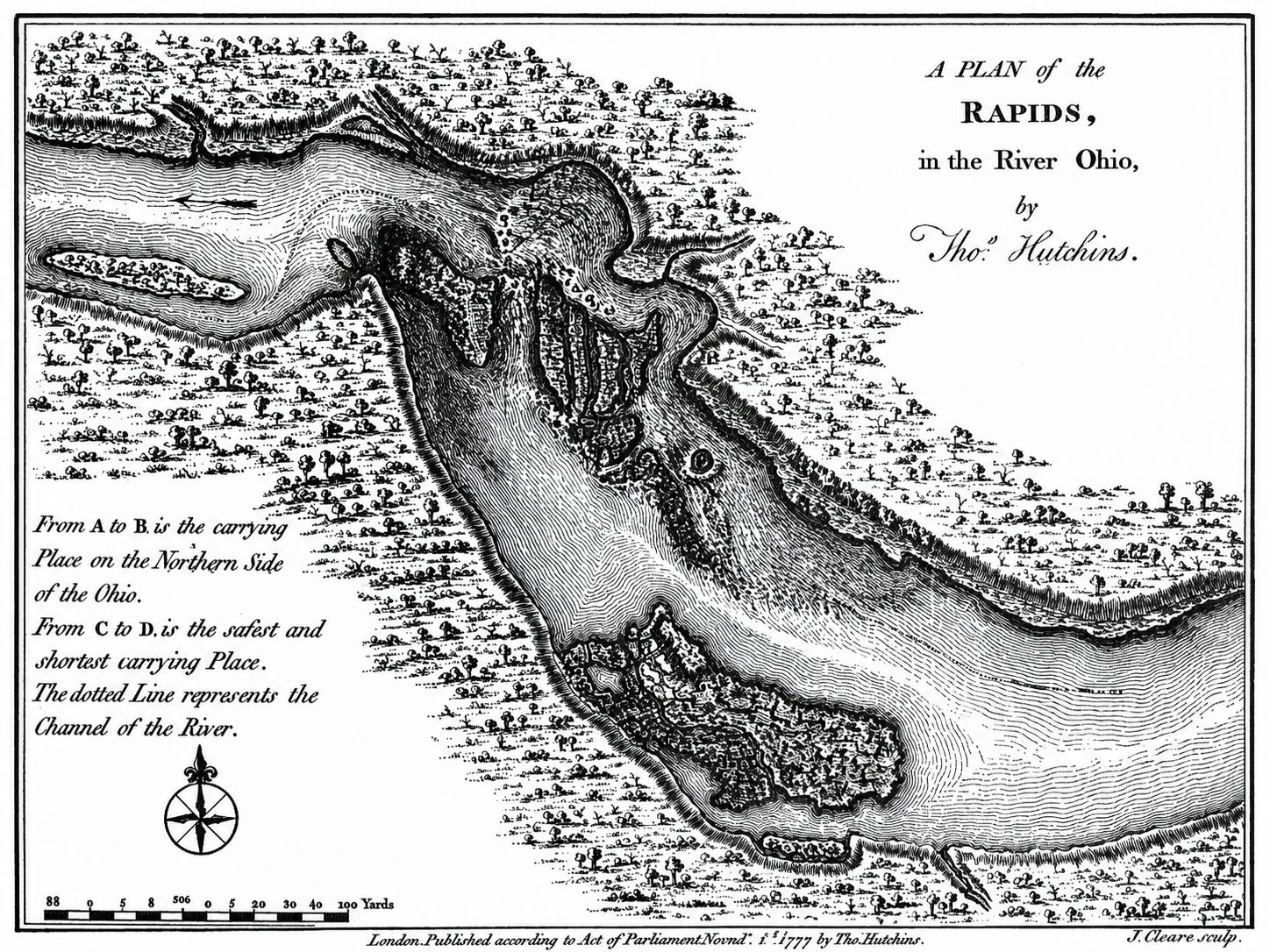
That is the part I return to. Corn Island was tiny. The force gathered there was small. The country itself was barely two years old, and there was no guarantee it would survive. Yet decisions made on that patch of river ground helped alter the geography of the nation that followed.
And among the people standing there were my fifth great-grandparents Andrew and Sally Kimbley, their daughter Sophia, my fourth great-grandmother, and my sixth great-grandfather Jacob Van Meter, who had helped recruit some of the roughly 175 men who made the expedition. None of them could have known, of course, that one of their descendants would still be thinking about that island nearly two and a half centuries later.
The island itself disappeared beneath the Ohio. Its consequences did not.
The river was the road, but at the Falls it made people stop. Some continued west. Others stayed. They built homes, established businesses, formed congregations, buried their dead, and left behind the records through which we now try to understand them.
The river was in charge then.
In many ways, it still is.
It carries away islands and rearranges shorelines. It floods houses, uncovers foundations, deposits trees in unfamiliar places, and reminds every generation that permanence is often something we imagine rather than something we possess.
And still people leave marks along its banks. They name streets. They plant gardens. They carve names into stone. They tuck letters into boxes and pass photographs from one generation to the next. They tell stories because they know, whether they admit it or not, that the river keeps moving.
The work of memory is not an attempt to stop it. It is an effort to place something in the hands of those traveling after us.
If there is a thread running through much of what I have done throughout my life so far, it is acknowledgment. I have always been drawn to the people, places, and stories that might otherwise pass unnoticed, and to the simple act of saying: this mattered, this person mattered, this was here.
I have wanted ordinary lives to matter. I have wanted forgotten people restored to the story, not because they were famous or powerful, but because they lived, struggled, loved, failed, endured, and belonged to someone. I have wanted records opened, cemeteries documented, and family stories preserved before the last person carrying them is gone. And I have wanted a parent living with dementia to experience the twilight of her life surrounded by familiarity, dignity, and the people who love her, even as so much else becomes uncertain.
More than anything, I have tried to make sure people are seen, remembered, and not left behind.
That work has taken many forms: finding an ancestor buried in a courthouse record, helping move a neglected collection toward digitization, or standing before a room of genealogists and urging them to back away from their screens and get into the field. The most important discoveries are not always found through the internet. They may be waiting in a cemetery, an attic, a family album, a church office, or a conversation we have postponed for too long.
The same principle has shaped some of the more private parts of my life.
Caregiving teaches you that love is rarely measured in grand gestures. More often, it is measured in routine.
You advocate for them when they can no longer advocate for themselves. You prepare the meals. You make the doctor’s appointments. You bathe them. You help them to the toilet. You answer the question you answered ten minutes ago. You explain where they are. You reassure them. And when the question comes again, you answer it again.
There will never be a monument to any of this activity.
That does not make it small.
There is an irony I have not been able to miss. I have spent much of my adult life trying to recover memory. I search old records for names that disappeared from family stories. I walk cemeteries looking for people time has nearly erased. I preserve photographs, documents, places, and fragments of lives because I believe remembering matters.
And then I come home and care for my mother as her own memories slip away.
A name disappears. A familiar story loses its ending. A place she once knew becomes unfamiliar. Something that happened yesterday may be gone by morning, while an event from seventy years ago can suddenly return with astonishing clarity.
For years I thought of memory as something that could be recovered if only you searched hard enough. Somewhere there was a record, a photograph, a letter, a stone in a cemetery, some surviving piece of evidence waiting to be found.
Dementia has taught me otherwise.
Sometimes there is no archive to consult. No courthouse drawer to open. No forgotten document that will restore what has been lost.
Sometimes the person who carried the record was the archive.
And when memory begins to leave them, love cannot always bring it back.
It can only stay.
That may be the hardest lesson caregiving has taught me. My work as a family historian is so often about rescuing what can still be rescued. Caring for my mother has required me to accept that some things cannot be preserved, no matter how badly I want to preserve them.
But perhaps preservation was never only about holding on.
Sometimes it is about bearing witness.
When my mother no longer remembers something, I can remember it for her. I can know the stories she once knew. I can recognize the people in the photographs. I can hold the continuity of a life even when she can no longer hold all of it herself.
The relationship changes, but it does not disappear.
Love learns another language.
Some days that language is conversation. Some days it is reassurance. Some days it is answering the same question five times without reminding her that she has already asked it. Some days it is simply sitting beside her and allowing the moment we are in to be enough.
And perhaps that is not so different from the rest of the work I have chosen to do.
A gravestone cannot remember the person beneath it. A courthouse ledger does not know the family whose names are written across its pages. A photograph cannot tell us who is standing in it.
Someone has to care enough to notice.
Someone has to remember.
Caregiving has taught me that a life cannot be measured only by what a person accomplishes. Sometimes the better measure is whom they stayed beside.
And preservation, I have come to think, is another form of staying beside.
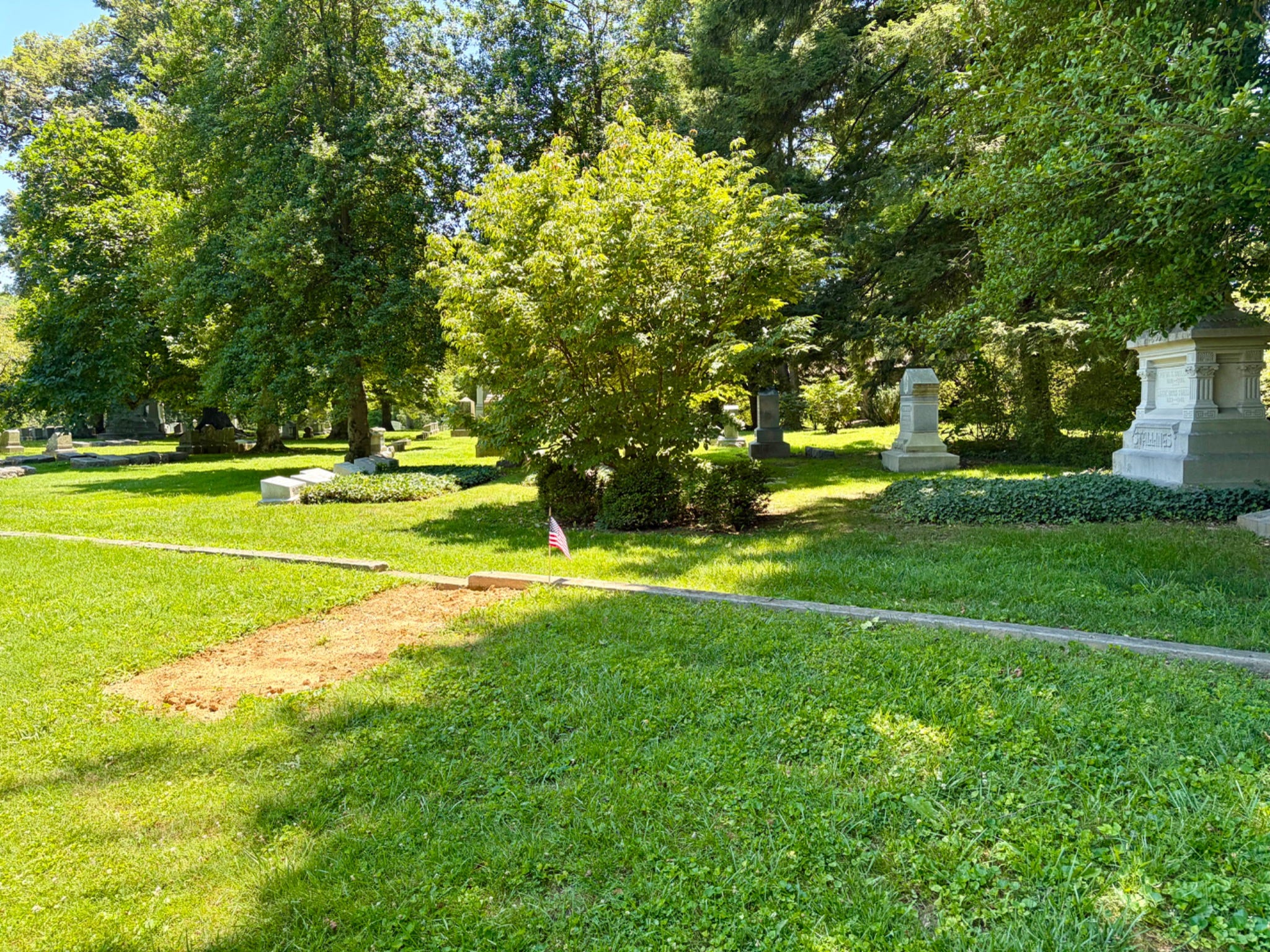
One day, of course, I will be on the other side of that equation. I will no longer be the person searching for the names, tending the stories, or standing beside the graves. I will be one of the names.
Someone may stop at my grave because they knew me. Another person may arrive decades later because my name appears in a family tree. Most will walk past without noticing it at all.
That is as it should be.
A grave does not need to command attention to fulfill its purpose. It marks a location. It gives memory an address. It tells those who care to look that a life occupied this place in the world.
And not far away will be the place where that life began.
There is a natural resolution in knowing this. I entered the world at St. Anthony’s Hospital, and my remains will rest within walking distance at Cave Hill. The geography is almost intimate, as though Louisville has reserved two places for me, one for arrival and one for departure.
Between them lies everything that cannot be shown on a map.
The people I have loved and the people I have lost. Hospital rooms and cemetery paths. Old photographs, courthouse ledgers, Kentucky sunsets, family stories, riverbanks, gardens tended by familiar hands, trees planted for those who would come after, speeches, and long nights spent chasing questions whose answers mattered to almost no one else.
The lives I have touched, and the lives that have touched mine.
I do not know when the train will arrive for me. I only know that someday it will, as it comes for every person in Spangenberg’s procession. When it does, I hope I can meet it with something of the quiet posture found in Friedrich’s figures, standing before the immensity of the world without pretending to be larger than it.
Until then, there is work worth doing.
People to care for. Stories to preserve. Names to recover from the edges of the page. Rivers to follow and cemeteries to walk. And, every so often, a moment when the light falls across Kentucky in a way that asks us to stop what we are doing and pay attention.
The distance between St. Anthony’s and Section A is short.
For now, I am still somewhere between them, carrying what I can.
Copyright 2026 Christopher Padgett
Staatliche Museen zu Berlin, Alte Nationalgalerie. “Abtei im Eichwald [The Abbey in the Oakwood].”
Staatliche Museen zu Berlin, Alte Nationalgalerie. “Abtei im Eichwald [The Abbey in the Oakwood].”
Staatliche Kunstsammlungen Dresden. “Das Große Gehege bei Dresden”; Herbert von Einem, “Friedrich, Caspar David,” Neue Deutsche Biographie 5 (1961)
Author’s calculation based on memorial counts for Cave Hill Cemetery, Calvary Cemetery, Eastern Cemetery, St. Louis Cemetery, and St. Michael Cemetery, Find a Grave, accessed 2026.
Indiana Historical Bureau. “Clark’s Daring Plan” and “The Campaign Begins.” George Rogers Clark: 225th Anniversary Exhibit.
Indiana Historical Bureau. “The Fall of Fort Sackville—Timeline”; National Park Service. “The Clark Campaign.” George Rogers Clark National Historical Park.
Indiana Historical Bureau. “Why Did Clark Attack the Illinois Country?”; National Park Service. “The Clark Campaign.”
These are the pieces you read once, read twice, and read again. Thank you, Christopher. We've missed your work and savor the moments you can duck in. May this transition be healing. 🫂
That is beautiful, Chris! Your words moved me. You put into clear thoughts why we have such depth of passion to uncover and share family stories. Thank you!!